
How Do Wildfires Affect Agriculture
Wildfires have been influencing ecosystems around the world for millions of years and continue to do so today. In fire-shaped landscapes like California, evidence of this can be seen in the fire-resistant physical adaptations of native flora, like the coastal redwood and giant sequoia. Like the landscape, people in fire-prone areas also adapted to living and working with fire.
No two wildfires are alike
In the same way that no two wildfires are alike, the effects of wildfires on the people and land in agricultural areas are drastically variable. The impacts can be direct, such as destroying crops, or indirect, like emotional distress in a community. The impacts can also be immediate or take years to realize, from pollution to respiratory illnesses to soil composition changes.
Wildfires can affect agriculture directly by:
- Destroying crops in the path of the fire
- Smoke and heat can destroy outer layers of crops not even seen by fire
- Emotional distress caused by wildfire
- Certain crops can add fuel to the wildfire
- Smoke inhalation and chemicals in the air can affect a farmer’s health
Around the end of the 19th century, there was a societal shift away from coexisting with wildfires in the United States. The focus on wildfire’s ability to destroy and devastate human life and property led to policies that focused on wildfire prevention and suppression. As it would later be discovered, wildfire suppression can be detrimental to ecosystems and the accumulation of natural debris, that was previously cleared by wildfires. This accumulating debris provides increased fuel for future wildfires.
How do wildfires affect agriculture?
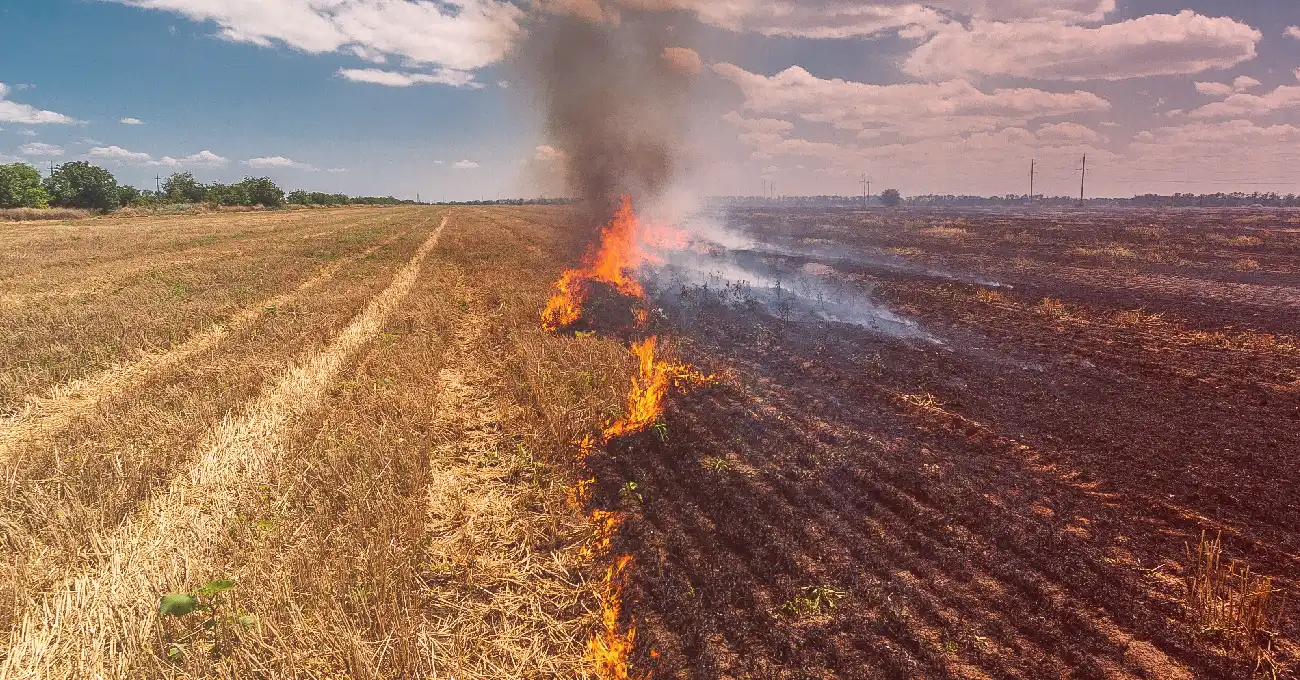
Wildfires can affect agriculture by damaging crops, orchards, livestock, farm infrastructure or affecting soil composition. Wildfires typically directly impact agricultural production and yield. While irrigated crops can be viewed as a “buffer” during a wildfire, wind-driven wildfires can easily burn well-irrigated crops. The heat from wind-driven fires can burn into multiple outer rows of crops, causing singeing, burning and even killing crops. Heat radiating directly from flames can damage sprinklers, fences and other agricultural infrastructure. Crops that are harvested when at a low moisture content, such as wheat and other grasses, can be especially susceptible to wildfires and many times fuel wildfires to a raging burn.
• Direct impacts on crops
Direct effects from wildfires on agriculture typically span periods of years to the affected farm. For example, if you have the three outer rows of your orchard scorched by a wildfire, it can affect your crop harvest for several years to come. If a farmer’s infrastructure is destroyed by a wildfire, it may affect their harvest depending on what equipment is ruined.
• Health and safety
Wildfires can also affect agriculture through the farmers who produce crops, farmland and work with farm animals. Health and safety should be taken very seriously for farmers, with wildfires being no exception. Many farmers assist with wildfire management in a time of need or are volunteer firefighters.
Farmers and their families are at high risk during wildfires for smoke and ash inhalation as well as chemical residue. Inhalation of wildfire smoke and gases can cause lasting effects on an agricultural worker’s lungs. Lost workdays can affect an agricultural farmer’s ability to produce crops. The extreme stress of wildfire season can also have an adverse effect on an agricultural farmer’s mental health.
• Wildfire management
Management of wildfires was previously focused on the burn. Controlled burns were intentional, deliberate, suppression stopped as soon as they started. Advances in technology now allow for influence to occur before the first curl of smoke rises into the sky until the last embers are extinguished.
How Can Benchmark Labs Help with the Impacts of Wildfire?
Current wildfire management strategies use historical management approaches, like suppression and controlled burns, that have broadened with technological advances. Benchmark Labs’ forecasting allows for predicting, preparing, and mitigating the effects of wildfires and creating intelligent decisions around when controlled burns should be administered. Forecasting, modeling and access to information are dependent on many factors; season, proximity, preparedness, quality and timeliness of the information.
From wine grapes to grazing lands, wildfires can have lasting effects on agriculture; let Benchmark Labs help you be prepared for a disaster.
Recent Posts

Cultivating Resilience: Benchmark Labs Joins Chipotle’s Cultivate Next Portfolio
Every single season, farmers around the globe face the same unpredictable challenge: the weather. From sudden frost windows to unprecedented heatwaves, agriculture has always been at the mercy of the elements. Today, shifting climate patterns are making those...
The Battle for the Sky: Is AI Taking Over Weather Forecasting?
For decades, weather forecasting has been the domain of massive supercomputers running complex physics-based simulations known as Numerical Weather Prediction (NWP) models. However, a new challenger has emerged: AI-driven models like Google’s GraphCast and Huawei’s...
Clear the Haze: Why Hyperlocal Weather Tech is the Key to Wildfire Prevention
Once again, millions of people across the US Midwest and Northeast are waking up to a dull orange sun and a throat-scratching haze. The latest Canadian forest fires have sent massive plumes of particulate matter traveling thousands of miles, triggering air quality...